
How Air Liquide Far Eastern is Investing in Taiwan’s Semiconductor Future
Artificial intelligence is changing the world, but booming demand is testing the capacity of chipmakers and the industries that support them. For Air Liquide Far Eastern, a leading supplier of industrial and electronic gases in Taiwan, that growth has brought a new challenge: keeping pace with customers while maintaining the quality, reliability, and resilience that advanced semiconductor manufacturing requires.
“We have to grow like a startup, even if we are a 100-year-old global company,” says Philippe Martinez, President of Air Liquide Far Eastern. “We are a well-established company with all the proper governance and procedures. But we need to make sure that we can absolutely deliver according to our customers’ expectations.”
The company’s Taiwan business is deeply rooted in semiconductors, and the industry’s pace of growth has changed how Air Liquide operates. Martinez notes that when the semiconductor industry that’s already operating at enormous scale grows by 30% a year, even a one-month delay can have significant consequences, not only for semiconductor manufacturers but also for their customers further down the supply chain. For Air Liquide, that means accelerating internal processes to meet customers’ increasingly demanding timelines.
“Being agile, flexible, and able to deliver in a matter of days is now the license to operate,” he says.
In recent years, Air Liquide Far Eastern has expanded production capacity, introduced leading technologies, and invested in new facilities to strengthen both operational efficiency and supply reliability as Taiwan’s semiconductor industry continues to grow. The company explains that these investments support increasingly advanced semiconductor manufacturing, where even trace impurities must be carefully monitored and controlled.
As Taiwanese semiconductor companies continue expanding internationally, Air Liquide’s role has evolved alongside them, facilitating their global expansion by drawing on its worldwide manufacturing footprint and operational experience.
Having a diverse and robust supply chain is essential for business continuity. For this reason, the company works closely with customers to evaluate sourcing strategies, assess risks, and develop resilient contingency plans. Martinez points to the company’s extensive global footprint as a key advantage. By leveraging its vast international network, Air Liquide can mobilize resources across regions or worldwide to ensure uninterrupted supply and keep operations running smoothly for customers in Taiwan.
Many of Air Liquide Far Eastern’s recent investments do more than expand capacity. They improve operational efficiency and reduce the carbon intensity of the company’s operations, showing how growth and decarbonization can advance together.
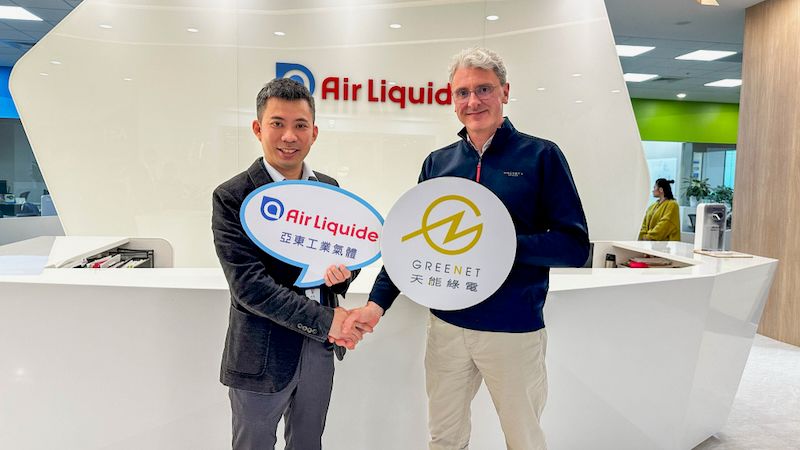
ALFE joins forces with GREENET to expand the use of renewable energy across its operations in Taiwan and accelerate industrial decarbonization. Photo Credit: ALFE
Efficiency improvement also links directly to lower carbon intensity.
Projects include Taiwan’s first renewable energy corporate power purchase agreement (CPPA) in the industrial gas industry and the commissioning of a carbon dioxide recovery facility. The company has also invested in underground pipeline systems that reduce transportation-related emissions while improving production efficiency — a practical example of how operational improvements can lower carbon intensity.
Looking ahead, Martinez believes meaningful emissions reductions will depend on three complementary factors: improving operational efficiency, expanding access to renewable energy, and advancing carbon capture technologies.
“If you don’t have these three pillars,” he says, “I really doubt your ability to deliver any significant commitment to reducing CO2 emissions.”
The company’s carbon dioxide recovery facility illustrates that approach. The facility captures approximately 90% of the byproduct CO2 generated during hydrogen production while increasing hydrogen output by 20%. The project improves production efficiency while reducing the product’s unit carbon footprint.
Taiwan’s long-term outlook remains closely tied to its commitment to science, innovation, and advanced manufacturing. Martinez believes Taiwan will continue strengthening its position, and he says Air Liquide Far Eastern will continue supporting that growth by helping customers operate more efficiently, reliably, and sustainably.
Business and Company
News Type
UN SDG
Share
Download
Source
by Taiwan Business TOPICS