
ACC’s "Butterfly Habitat Creation Philanthropy Project" Reaches Changbin Junior High School
Building ecological habitats tailored to local environments to expand butterfly corridors
To promote ecological education and natural habitat restoration, Asia Cement Corporation continues to drive its "Butterfly Habitat Creation Philanthropy Project." Recently, the Asia Cement Ecological Park team visited Changbin Junior High School in Taitung County to collaborate with teachers and students in establishing a campus butterfly habitat. In addition to donating butterfly host plants suited for coastal environments—including Aristolochia (Dutchman's pipe), Parsonsia alboflavescens, and Dregea volubilis—the team also conducted ecological education sessions to introduce students to butterfly ecology and natural cycles.
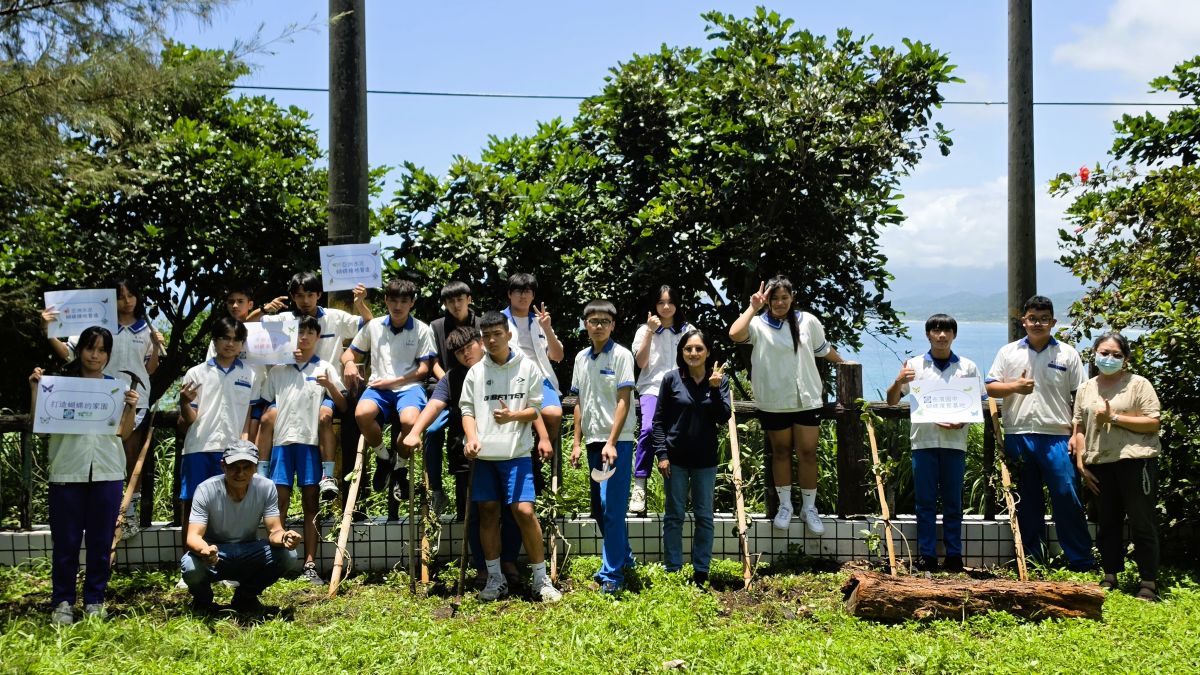
The Asia Cement ecological team and students from Changbin Junior High School work together to build a campus butterfly habitat. (Photo Credit: ACC)
The Asia Cement Ecological Park team pointed out that Changbin Junior High School, situated between the mountains and the sea, possesses an excellent natural environment and a solid foundation for environmental education. Therefore, this habitat layout was specially planned to align with the local climate and campus conditions. By adhering to the principle of "the right plant for the right place," the project aims to create a natural learning space closely integrated with the local ecology while enhancing biodiversity on campus.
In the future, the Changbin Junior High School campus is expected to attract species such as the Golden Birdwing (Troides aeacus), the Paper Kite Butterfly (Idea leuconoe), and the Dark Blue Tiger (Tirumala septentrionis). This will allow students to observe up close the life cycle of butterflies—from egg-laying and larvae to pupation and emergence—extending environmental education from the classroom into daily life as a meaningful part of the children's growth.
The core vision of Asia Cement’s Butterfly Habitat Creation Philanthropy Project goes beyond building isolated butterfly gardens. Instead, it aims to connect campuses, communities, and local environments to gradually form "butterfly corridors" where butterflies can migrate, rest, and breed. By planting host and nectar plants tailored to different butterfly species, fragmented green spaces are transformed into interconnected ecological nodes, facilitating the dispersion and habitation of butterfly populations while giving more children the opportunity to connect with nature in their daily lives.
However, off-site restoration of butterfly habitats cannot be easily mass-replicated like conventional philanthropic projects. Beyond requiring long-term manpower and maintenance, the greatest challenge lies in the prolonged cultivation of host plants, which typically takes one to two years to lignify (woody growth) before they are suitable for transplantation and donation. Furthermore, the period from completing the habitat to actually attracting butterflies requires patience, time, and observation, which serves as a test of a school’s long-term commitment to maintenance and stewardship.
Consequently, prior to initiating any collaboration, Asia Cement evaluates a school's vision and subsequent planning for the habitat. The company seeks partners who are committed to more than just short-term event participation—they must demonstrate true determination and practical approaches toward long-term maintenance, ecological education promotion, and sustainable operations, ensuring the habitat delivers lasting ecological and educational value.
Since its launch in 2021, Asia Cement's Butterfly Habitat Creation Philanthropy Project has successfully established butterfly habitats across 44 schools and locations throughout Taiwan. By continuously connecting campuses and communities nationwide, the initiative takes ecological education to the grassroots level, turning previously overlooked corners into vital habitats for butterflies and natural ecosystems.
Looking ahead, Asia Cement welcomes more schools and communities to join the butterfly corridor network to jointly expand this ecological connection. Schools interested in applying for butterfly habitat creation, promoting ecological education, or participating in the butterfly corridor initiative are encouraged to contact the Asia Cement Ecological Park to collaboratively build a friendlier environment for ecology.
Asia Cement Ecological Park https://accpark.org/
Business and Company
News Type
UN SDG

Share
Download
Source
Asia Cement