

From Efficiency to Resilience: FET Talks about Enterprise AI Applications
The “2025 Innovation Forum,” hosted by the Economic Daily News, commenced today (26th) under the theme “AI × Smart Application” The event convened prominent leaders and experts across diverse industries to examine how enterprises can deepen AI adoption while maintaining operational efficiency and enhancing organizational resilience.
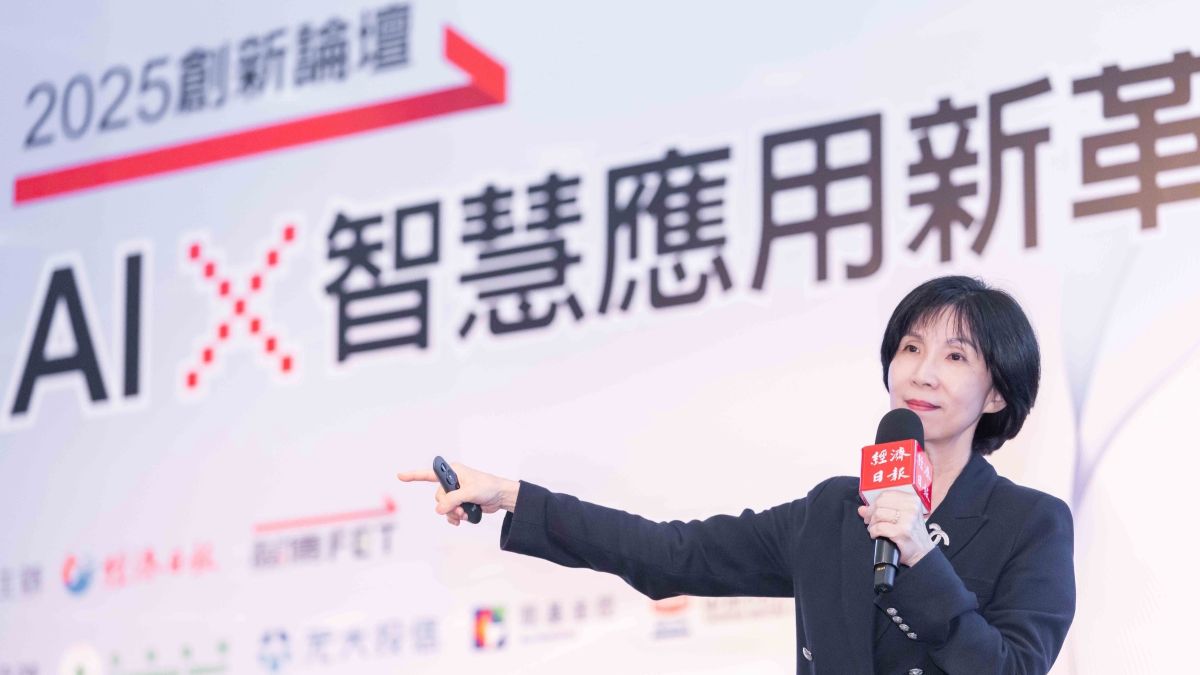
FarEasTone Telecommunications President Chee Ching (Photo Above by FET) delivered a keynote address titled “From Efficiency to Resilience: Strengthening Enterprise AI Applications,” in which she outlined FarEasTone’s comprehensive approach to AI transformation and shared practical operational insights. Her address highlighted the company’s dual strategy of “internal and external AI deployment,” emphasizing both the enhancement of internal efficiency and the expansion of innovative AI-driven services for customers and partners. Lee, Ming-hsien, President of Information Security Service Digital United (ISSDU), a subsidiary of FarEasTone, also joined the forum. He offered a forward-looking analysis of how enterprises can establish strong digital resilience in the AI era, underscoring the critical importance of cybersecurity, risk governance, and continuous technological evolution.
Four Steps to Enterprises Implementing Generative AI
Chee emphasized that generative AI has significantly lowered the threshold for AI adoption and broadened its practical applications, a development that is fundamentally reshaping corporate operating models. Douglas Tong Hsu, Chairman of Far Eastern Group and FET, has long regarded technology and innovation as strategic priorities. Guided by the philosophy that “AI is Everything,” FET has not only integrated generative AI into its internal operations to enhance employee productivity and streamline processes but has also independently developed the “FET AI Genie,” an enterprise-grade AI platform now being offered to external partners. Through this platform, FET is actively supporting businesses in adopting AI technologies to strengthen efficiency and operational resilience across functions including customer service, operations, and decision analytics.
According to Chee, enterprises seeking to implement generative AI must follow four essential steps. The first is to identify opportunities and clarify the problems they intend to solve, rather than pursuing AI for its own sake. The second is to select suitable AI platforms and tools, keeping in mind that “wanting to drink milk does not require raising the cow yourself,” and ensuring smooth integration with existing IT environments to minimize learning costs and internal resistance. The third step is data preparation, which involves assessing and organizing “usable data” to support AI deployment. The final step is implementation —an effort that should not be confined to the technical department but instead involve employees at all organizational levels, ensuring that AI becomes a shared, ubiquitous tool across the enterprise.
FET Adopts AI Strategy: Points, Lines, And Surfaces
Generative AI is catalyzing a “white-collar revolution,” with human–computer collaboration poised to become the dominant work model of the future. Chee noted that enterprises must establish clear objectives, structured plans, transparent communication, rapid execution, and measurable outcomes when deploying AI initiatives. FET has adopted an implementation approach that progresses from “points,” to “lines,” and ultimately to “surfaces”: first providing employees with secure AI tools to enhance individual efficiency; subsequently positioning AI as an assistant within each team to strengthen team-level performance; and finally leveraging AI to optimize cross-functional processes, thereby elevating overall productivity and supporting a more balanced integration of work and life.
Chee further explained that the fundamental purpose of AI adoption within enterprises remains consistent: to reduce costs and to increase revenue. Drawing from its own implementation experience, FET has distilled four core performance indicators—boosting employee productivity, enhancing operational efficiency and organizational resilience, enabling service and business model innovation, and elevating customer satisfaction. These targets not only guide FarEasTone’s AI strategy but also serve as practical reference points for most organizations seeking to identify effective pathways for AI integration.
Cost Reduction and Revenue Increase with Results
FET extensively applies M365 Copilot across employees’ daily workflows, encouraging all departments to identify use cases for generative AI in functions such as product management, retail, legal affairs, accounting and administration, procurement, and IT development to substantially reduce repetitive manual tasks. Examples include leveraging Copilot to review lease agreements and analyze summary documents, reducing average working hours by 66% and 95%, respectively; automating approval-request logging, repair management, and maintenance-contract reviews, saving more than 2,000 minutes per month; significantly reducing supplier verification efforts and the management time for expiring contracts by 75% to 90%; and shortening KYC verification time by 60% to 99%.
FarEasTone’s IT operations division is also deploying generative AI to optimize cross-team processes, allowing domain experts to collaborate with the AI assistant “Operation Smart Genie”. This enables autonomous learning, accelerated innovation, rapid replication of successful scenarios, and the development of a shared operations platform. Through these enhancements, FET has improved operational efficiency and reduced manpower required for incident analysis by 30 % to 50%. The network technology team likewise harnesses AI to integrate historical incident records and more than 300 operational manuals and documents, enabling rapid identification of problem sources, automating work-order scheduling, expediting learning and troubleshooting, and issuing early-stage risk alerts. These measures collectively strengthen network operational efficiency and organizational resilience.
FET is also embedding generative AI into its products and solutions to elevate customer experience and unlock new business opportunities. For example, FarEasTone’s friDay Video streaming service employs generative AI to deliver conversational movie recommendations that integrate semantic and sentiment analysis, keyword retrieval, and semantic vector–based search technologies. This has resulted in a sevenfold increase in click-through rates. With AI-driven enhancements, sales performance during the Double 11 shopping festival rose by 1.6 times compared with the previous year, while new member registrations more than doubled.
On the enterprise front, FET incorporates AI into its proprietary IoT platform to support a wide array of smart-city applications, combining AI to refine power-demand forecasting, energy-saving device control, and streetlight monitoring and adjustment. FET further leverages Digital Twin technologies to construct a virtual-physical integrated platform capable of real-time data linkage, forward-looking simulation, and risk prediction, thereby strengthening decision-making and operational management. In addition, FET deploys its self-developed FET AI Genie platform to help organizations rapidly implement generative-AI applications, achieving demonstrable results across sectors including public administration, education, healthcare, technology, financial services, port operations, transportation, and food retail.
Focus on the Future Prospects of AI: Three Aspects
FET applies AI extensively in fraud prevention, enabling the blockage of suspicious calls within two hours, intercepting more than 90% of fraudulent text messages through semantic analysis, blocking 31 million high-risk links each month, and automatically filtering inappropriate content for children. These measures collectively establish a comprehensive safeguard for user security. FET has also developed an AI-driven intelligent customer service system capable of real-time responses and predictive engagement, offering proactive services such as travel insurance reminders and personalized interactions to enhance customer experience and optimize workforce deployment. In 2025, the average monthly usage reaches 400,000 interactions, enabling the customer service team to save an estimated NT$54 million in annual labor costs.
Chee emphasized that AI will evolve toward an “agent-based model” in the future. To stay aligned with this transformation, enterprises must reassess their organizational structures and operational workflows, while leveraging AI to build a corporate intelligence core and strengthen talent continuity, operational safety, and ongoing innovation. Only by fully amplifying AI’s synergistic power can organizations establish multidimensional resilience and achieve sustainable, long-term growth.
Business and Company
News Type
UN SDG

Share
Source
FarEasTone (Machine Translation)