FET Unveils Net-Zero and Disaster-Resilient Microgrid Solutions for Public Buildings at 2026 Smart City Summit & Expo
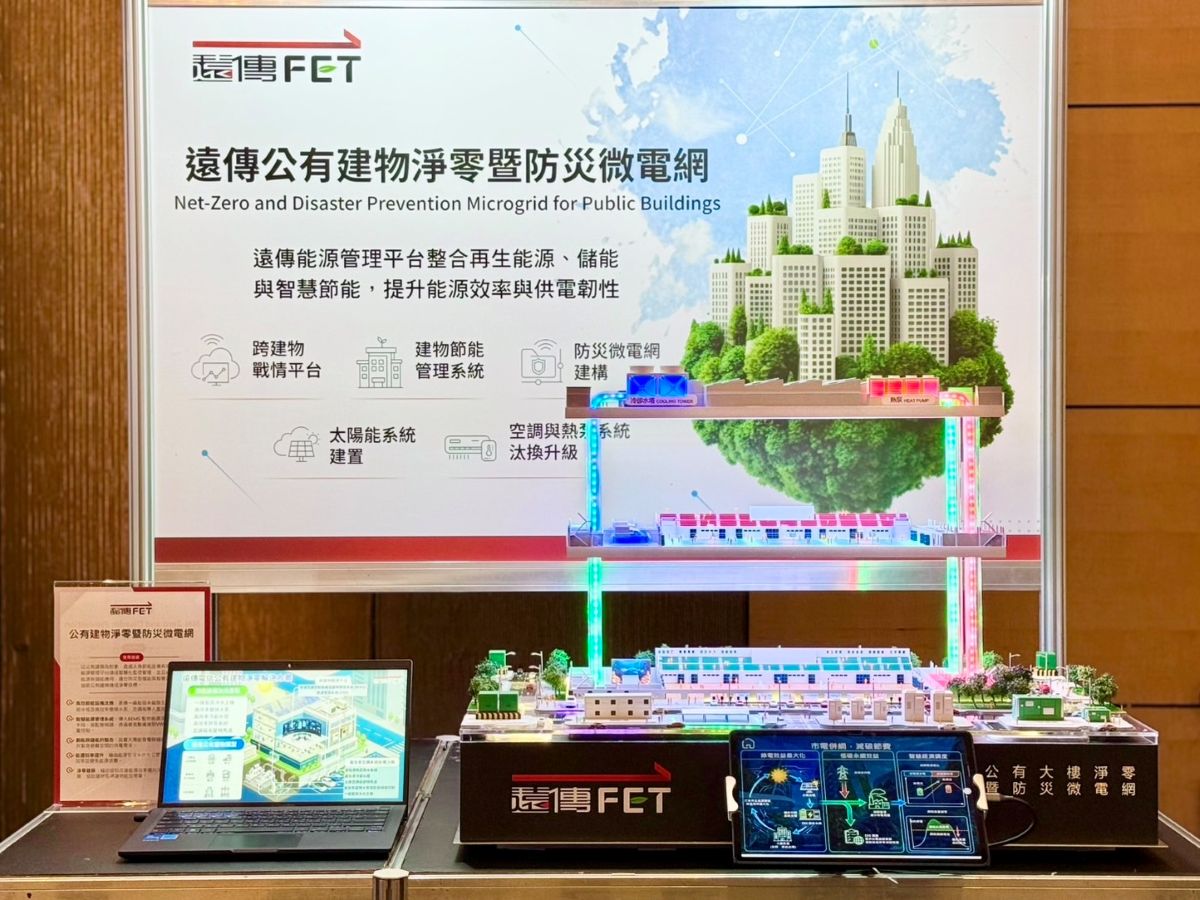
Ahead of the "2026 Smart City Summit & Expo" set to open next Tuesday (March 17), a joint pre-exhibition press conference was held today (March 10). Far EasTone Telecommunications (FET) took center stage with the debut of its "Net-Zero and Disaster-Resilient Microgrid" solution. Aligning with Taiwan’s 2050 Net-Zero Roadmap, FET assisted the National Taiwan Ocean University (NTOU) Gymnasium in implementing three key steps: high-efficiency energy-saving equipment replacement, smart energy management systems, and the integration of energy generation and storage. This initiative improved the building's Energy Use Intensity (EUI) by 42% and earned the top "Level 1+" Building Energy Efficiency Rating, establishing a benchmark for net-zero public buildings while enhancing energy resilience through a disaster-resilient microgrid. (Photo Credit: FET)
Strengthening Energy Resilience for Sustainable Cities
Philip Tseng, Executive Vice President of the Enterprise and International Business Group at FET, stated that in the face of challenges posed by extreme weather, smart cities require not only carbon reduction but also a transition toward sustainability that incorporates energy resilience. "Leveraging our extensive experience in ICT integration within energy management and microgrids, FET is actively developing applications for net-zero and disaster-resilient storage for public buildings," Tseng noted. FET combines equipment upgrades with renewable energy, storage, and smart energy-saving mechanisms to offer a complete solution for office buildings, campuses, stations, hospitals, and museums.
Creating a Benchmark: 42% Improvement in Energy Efficiency at NTOU
FET facilitated a comprehensive upgrade of the NTOU Gymnasium’s legacy systems, including air conditioning, chillers, cooling towers, and variable-frequency pumps, to Grade 1 energy-efficient equipment. By deploying a Building Energy Management System (BEMS) integrated with real-time temperature sensing and automated controls, FET achieved the following results:
- Power Reduction: Total air conditioning power consumption decreased by 19%.
- EUI Improvement: The EUI dropped significantly from 122.1 to 70.3, marking a 42% improvement.
- Certification: Successfully secured the Level 1+ Building Energy Efficiency Rating, creating a model for "Nearly Zero-Carbon Buildings".
Disaster-Resilient Microgrid: 72 Hours of Autonomous Power
For the gymnasium’s emergency shelter spaces, FET installed a renewable energy and storage system. By utilizing rooftop solar power for self-consumption and outdoor storage units, FET created a "Disaster-Resilient Microgrid" capable of fully automated switching between "Grid-Connected" and "Island" modes.
- Standard Operation: Optimizes solar and storage efficiency during normal conditions.
- Emergency Mode: In the event of an outage, the storage system immediately switches to independent operation, providing stable power for over 72 hours.
- Critical Support: Ensures autonomous operation for essential lighting, communication, and medical equipment, transforming the community shelter into a resilient safe haven.
Looking ahead, Far EasTone will continue to assist more public facilities and large venues in their transition toward net-zero architecture, achieving energy autonomy while enhancing overall disaster prevention and operational resilience.
Business and Company
News Type
UN SDG
Share
Source
AI Translation of Chinese Press Release